Diving into Embedded Software Development: A Beginner’s Guide
Embedded software development is the foundation of modern electronics. From smartphones and smart TVs to automobiles, medical devices, and industrial automation, embedded systems silently power the world around us. This beginner-friendly guide explains what embedded software is, why it matters, and what topics you should learn to get started confidently.
If you are passionate about low-level programming, electronics, and real-world problem solving, embedded systems is one of the most rewarding technology domains to explore.
🔍 What Is Embedded Software Development?
Embedded software is specialized code written to run on dedicated hardware such as microcontrollers (MCUs) and microprocessors (MPUs). Unlike desktop or mobile applications, embedded software is:
-
Designed for specific tasks
-
Runs with limited memory and CPU power
-
Closely interacts with hardware registers
-
Often required to operate in real time
-
Built for reliability and long-term operation
Example:
A washing machine controller reads button inputs, manages water levels, controls motors, and ensures safety—all using embedded firmware.
🌍 Why Embedded Systems Are Important
Embedded systems are everywhere:
-
🚗 Automotive: Engine control units, ABS, airbags
-
🏥 Medical: ECG machines, infusion pumps
-
🏭 Industrial: PLCs, robotics, automation systems
-
📱 Consumer Electronics: Smart TVs, wearables
-
🌐 IoT Devices: Smart sensors, gateways, home automation
Without embedded software, hardware cannot function intelligently.
💡 Motivation to Learn Embedded Systems
1. Control the Physical World
Embedded development lets your code interact with real hardware—LEDs blink, motors rotate, sensors respond.
2. High Industry Demand
Embedded engineers are highly valued in automotive, aerospace, medical, and IoT industries.
3. Strong Technical Foundation
You gain deep understanding of:
-
Memory management
-
Interrupts and timing
-
Hardware–software interaction
-
Performance optimization
4. Gateway to Advanced Technologies
Embedded knowledge leads to careers in:
-
IoT system design
-
Robotics
-
RTOS development
-
Firmware security
📚 Topics Covered in Embedded Software Development
🔌 Basic Electronics
-
Voltage, current, resistance
-
Ohm’s Law
-
Digital vs analog signals
-
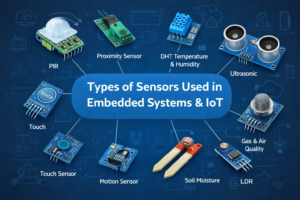
Sensors and actuators
🧠 Microcontrollers & Hardware
-
MCU architecture
-
Flash, RAM, peripherals
-
GPIO, timers, ADC
-
Datasheets & reference manuals
🧑💻 Embedded Programming
-
Embedded C fundamentals
-
Pointers and memory
-
Bitwise operations
-
volatilekeyword -
Introduction to Embedded C++
⚙️ Toolchains & Debugging
-
Compilers and linkers
-
IDEs and build systems
-
JTAG / SWD debugging
-
Firmware flashing
⏱️ Real-Time Concepts
-
Polling vs interrupts
-
ISR best practices
-
Timers and scheduling
-
Deterministic execution
🧵 RTOS Basics
-
Tasks and threads
-
Scheduling algorithms
-
Semaphores and mutexes
-
RTOS vs bare-metal systems
🔗 Communication Protocols
-
UART
-
I2C
-
SPI
-
CAN (intro)
-
USB basics
🌐 Embedded & IoT
-
Connected devices
-
Sensor data processing
-
Power optimization
-
Firmware updates
🛠️ Debugging & Optimization
-
Memory analysis
-
Stack vs heap
-
Logging techniques
-
Common beginner mistakes
🚀 How Beginners Should Start Embedded Systems
-
Start with LED blinking
-
Learn register-level programming
-
Read datasheets regularly
-
Debug often—mistakes are learning
-
Build small projects consistently
✅ Final Thoughts
Embedded software development is not just programming—it is engineering with responsibility. Your code may run for years without failure, controlling critical systems.
If you enjoy electronics, low-level software, and solving real-world problems, embedded systems is a career path worth pursuing.