
Basics of Electronics
Introduction to Electronics
Electronics is a branch of science and technology that deals with the study, design, and application of circuits and devices utilizing the flow of electrons. This essential discipline plays a vital role in our everyday lives, intertwining seamlessly with various aspects of technology and engineering. From household appliances to advanced computing systems, the influence of electronics is pervasive, making it crucial for beginners to gain a foundational understanding of its principles.
At its core, electronics involves the manipulation of electrical energy to design circuits that perform specific functions. These functions range from simple tasks, like switching on a light bulb, to complex operations in embedded systems found within smartphones and other digital devices. A basic grasp of electronics also encompasses understanding components such as resistors, capacitors, and logic gates, which are the building blocks of circuits and embedded systems.
The relevance of electronics extends into various fields including telecommunications, automotive systems, healthcare, and consumer electronics. For instance, the integration of electronics in modern vehicles enhances safety through advanced driver-assistance systems and infotainment services. Similarly, electronics has revolutionized healthcare with devices such as pacemakers and diagnostic equipment, improving the quality of patient care.
Having a foundational knowledge in basic electronics is beneficial not only for aspiring engineers and technicians but also for individuals looking to navigate a tech-driven society. It equips learners with the skills necessary to troubleshoot home devices, engage with smart technologies, and appreciate the innovative advancements shaping our world. Thus, a well-rounded comprehension of electronics, embedded systems, and their practical applications can open up myriad opportunities across various sectors.
Understanding Resistors
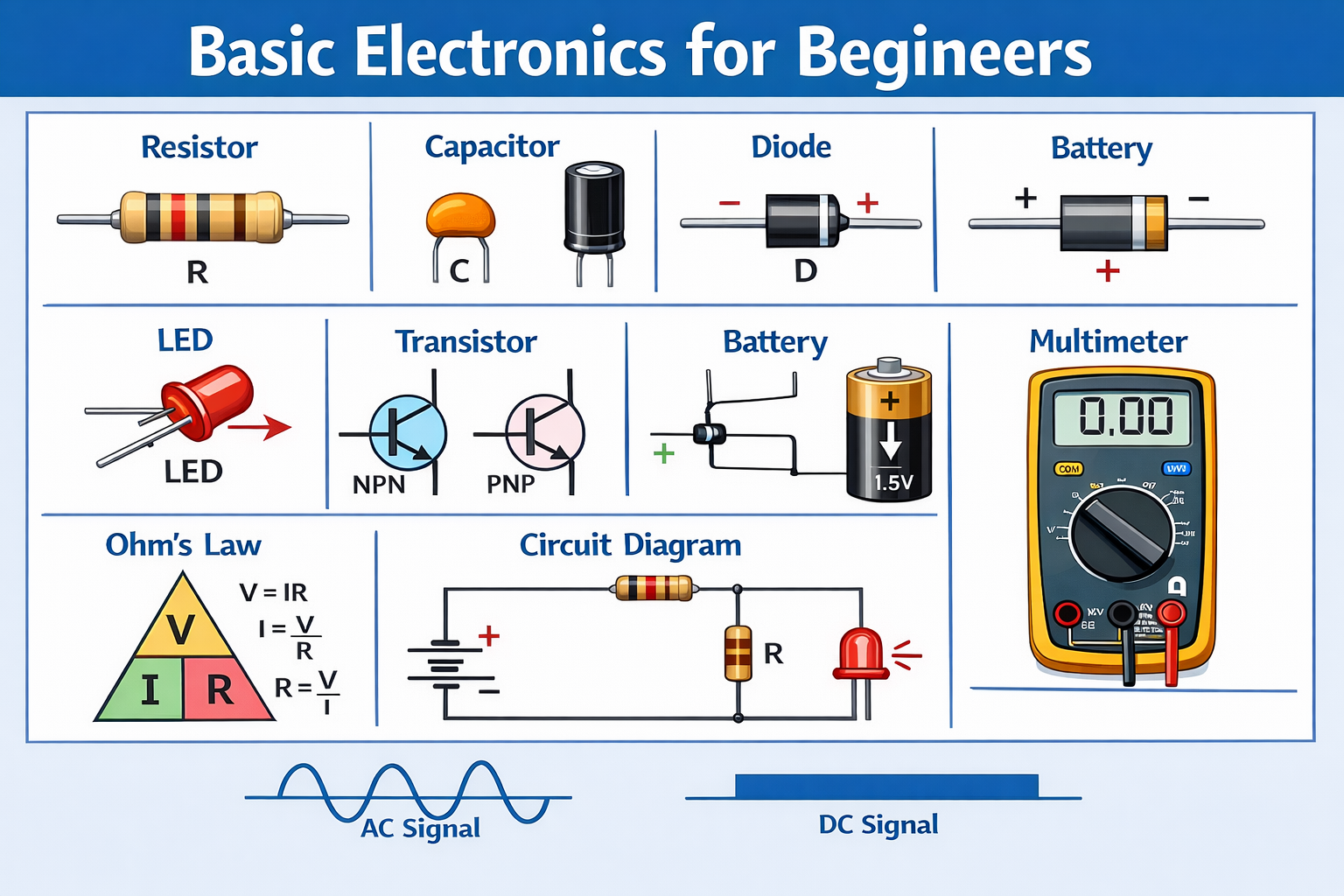
Resistors are fundamental components in the field of electronics, utilized to control the flow of electric current in a circuit. They are designed to provide a specific amount of resistance, which is measured in ohms. The primary function of a resistor is to limit the current that flows through an electronic circuit, ensuring it operates within safe parameters. This characteristic is essential for protecting delicate components from damage caused by excessive current.
According to Ohm’s Law, which states that voltage (V) equals current (I) multiplied by resistance (R), one can easily calculate the relationship between these variables. Understanding this principle is crucial for anyone studying basic electronics, as it forms the backbone of circuit analysis. For example, if one knows the voltage in a circuit and the resistance value of a resistor, they can compute the current flowing through that resistor.
Resistors come in various types, each serving unique purposes in embedded systems and electronic projects. The most common types include fixed resistors, variable resistors (or potentiometers), and specialty resistors such as thermistors and photoresistors. Fixed resistors maintain a constant resistance value, while variable resistors allow for adjustments to this value, making them versatile in applications like adjusting volume in audio devices. Furthermore, specialty resistors respond to environmental changes, adding functionality to electronic designs.
In practical applications, resistors can be found in almost every electronic device, from simple circuits to complex embedded systems. For instance, they are indispensable in controlling voltage levels, dividing currents, and creating timing circuits with logic gates. Understanding how to implement resistors effectively is a stepping stone for mastering electronics.
Capacitors: An In-Depth Look
Capacitors are fundamental components in the field of electronics that serve the crucial function of storing electrical energy. They consist of two conductive plates separated by an insulating material, often referred to as a dielectric. When voltage is applied across the plates, an electric field is established, allowing the capacitor to store energy until it is needed in a circuit. This property makes capacitors essential in various applications, particularly in embedded systems and as part of vital components in electronic devices.
There are several types of capacitors, each with distinct characteristics and applications. The most common types include ceramic, electrolytic, tantalum, and film capacitors. Ceramic capacitors are often used for high-frequency applications due to their stability and reliability. On the other hand, electrolytic capacitors offer higher capacitance values, making them suitable for applications requiring significant energy storage, such as power supply circuits.
Capacitors are also categorized based on their polarity; for instance, electrolytic capacitors are polarized, meaning they must be connected in a specific orientation within a circuit. This characteristic is critical to prevent failure. Furthermore, capacitors can be found in various electronic devices, from smoothing out voltage fluctuations in power supplies to acting as timing elements in oscillators. Understanding the role of capacitors in basic electronics is vital for anyone preparing to delve deeper into firmware and system-level design.
In conclusion, a comprehensive knowledge of capacitors and their applications significantly enhances one’s ability to engage with logic gates and other components in electronics. Aspiring engineers and electronics enthusiasts should prioritize mastering the characteristics and functions of capacitors to pave the way for successful implementation in future projects.
The Role of Inductors in Electronics
Inductors play a pivotal role in the field of electronics, serving as fundamental components within electronic circuits. They are passive devices that store energy in a magnetic field when electrical current flows through them. The basic principle governing inductors is known as inductance, which is the tendency of an inductor to resist changes in the current flowing through it. This property distinguishes inductors from other components like capacitors and resistors.
Unlike capacitors, which store energy in an electric field and release it rapidly, inductors accumulate energy in the form of magnetic fields, leading to delayed responses in current changes. Resistors, on the other hand, simply impede current flow without storing energy. This fundamental difference makes inductors invaluable in filtering, tuning, and energy storage applications in various electronic devices.
Inductors come in various types, such as air-core, iron-core, and ferrite-core inductors, each designed for specific applications within electronic circuits. Air-core inductors are lightweight and used in high-frequency applications, while iron-core inductors provide higher inductance values in a smaller size, making them suitable for power supplies and transformers. Ferrite-core inductors are commonly used in applications like noise suppression and signal processing due to their efficiency in high-frequency situations.
The practical applications of inductors are extensive, spanning across devices such as radios, televisions, and power supplies. In embedded systems, inductors are crucial for filtering out unwanted signals and stabilizing power supplies to ensure optimal functionality. Their ability to work seamlessly with other components, including firmware-driven systems, underlines their significance in modern electronics. Understanding the properties and functions of inductors lays the groundwork for mastering basic electronics and advancing into more complex concepts such as logic gates and integrated circuits.
Understanding Diodes and Their Uses
Diodes are essential electronic components that serve as semiconductor devices allowing current to flow in one direction while blocking it in the opposite direction. Their fundamental function is to control the direction of current flow within a circuit. This capability makes diodes particularly vital in applications involving power conversion, signal processing, and protection of sensitive components in embedded systems.
There are several types of diodes that serve various purposes in the realm of basic electronics. For instance, rectifier diodes convert alternating current (AC) to direct current (DC) by allowing current to pass through during one phase of the cycle, effectively blocking the reverse phase. Zener diodes, on the other hand, are designed to allow current to flow in both directions, but they maintain a constant voltage level when in reverse breakdown. This feature makes them invaluable for voltage regulation in electronic devices as they can prevent voltage spikes from damaging other components.
Another notable example is the light-emitting diode (LED), which emits light when current flows through it. LEDs can be utilized in various applications, including indicators, displays, and general lighting. In embedded systems, the selection of the appropriate diode type can significantly enhance functionality, reliability, and efficiency. For circuit designers, understanding these diodes and their unique characteristics is crucial when working with logic gates and integrating firmware into electronics.
Upon exploring the diverse types of diodes and their applications, it becomes clear that these semiconductor devices play a pivotal role in the effective functioning of electronic circuits. Grasping their uses and functionalities contributes substantially to a beginner’s foundational knowledge in electronics and embedded systems.
Transistors: The Building Blocks of Modern Electronics
Transistors are fundamental components in the world of electronics, serving primarily as switches or amplifiers within various electronic circuits. Their significance cannot be overstated, as they form the backbone of modern electronic devices, ranging from simple calculators to complex embedded systems found in smartphones and computers. Understanding the different types of transistors is crucial for anyone starting in basic electronics.
There are several types of transistors, but the two most common varieties are bipolar junction transistors (BJTs) and field-effect transistors (FETs). BJTs function by controlling the flow of current through a semiconductor material, using a small input current to control a larger output current. This characteristic makes them useful in amplification applications, ensuring that weak signals can be boosted efficiently. In contrast, FETs utilize an electric field to control the flow of current, providing high input impedance and low power consumption, which are essential traits in many electronic applications.
Transistors are also integral to the design of logic gates, which are the building blocks of digital circuits. Logic gates such as AND, OR, and NOT gates utilize transistors for their operations, permitting the construction of complex computational circuits. These gates can be combined in myriad ways to create intricate electronic systems capable of performing advanced functions. Moreover, transistors are used extensively in various configurations, including current amplifiers, signal modulators, and as switching devices in power electronics.
The role of transistors in modern technology continues to evolve with advancements in microelectronics and semiconductor manufacturing techniques. As electronics advance further into areas such as automation, the Internet of Things, and artificial intelligence, transistors will remain indispensable components, underpinning the effectiveness and efficiency of countless devices.
Circuit Theory: Basic Concepts and Laws
Circuit theory serves as the backbone for understanding electronics and embedded systems. At its core, it encompasses the study of how electric components interact within a circuit. To begin, it is essential to differentiate between two basic configurations of electrical circuits: series and parallel circuits. In a series circuit, components are connected end-to-end, resulting in a single pathway for current flow. In this configuration, the total voltage is divided among the components, while the current remains constant. Conversely, parallel circuits offer multiple paths for current flow, allowing each component to receive the same voltage while the total current is the sum of the currents through each branch.
Kirchhoff’s laws play a pivotal role in circuit analysis. According to Kirchhoff’s Current Law (KCL), the total current entering a junction must equal the total current leaving that junction. This principle is crucial when analyzing circuits with multiple paths. On the other hand, Kirchhoff’s Voltage Law (KVL) states that the sum of the electrical potential differences (voltage) around any closed circuit loop must equal zero. These laws provide essential guidelines for solving circuit problems and are fundamental to your understanding of basic electronics.
To analyze simple electrical circuits, it is important to apply Ohm’s Law, which relates voltage (V), current (I), and resistance (R) through the equation V = IR. This relationship is foundational in determining how components like resistors, capacitors, and power sources behave within a circuit. Furthermore, utilizing logic gates in digital circuits relies heavily on these principles, as they involve binary states to carry out logical operations requisite for firmware development.
Understanding these basic concepts of circuit theory sets the stage for delving deeper into more complex systems in electronics and embedded systems. It equips aspiring engineers and hobbyists with the necessary tools to analyze, design, and troubleshoot circuits effectively.
Essential Tools and Equipment for Beginners
Embarking on a journey into the world of electronics requires the right set of tools and equipment. These items not only facilitate the learning process but also ensure safety and efficiency while experimenting with various embedded systems. Here are some of the fundamental tools that beginners should consider acquiring.
One of the most crucial tools is the multimeter. This multifunctional instrument is essential for measuring voltage, current, and resistance. For beginners, learning how to utilize a multimeter is pivotal to understanding basic electronics concepts such as Ohm’s law. A multimeter not only aids in troubleshooting circuits but also helps in verifying the specifications of components used in projects.
A breadboard is another indispensable tool. It allows beginners to prototype electronic circuits without the need for soldering. Its reusable slots make it perfect for practicing and experimenting with different embedded systems. By using a breadboard, learners can easily make modifications to their circuits, fostering a hands-on approach to understanding logic gates and their functionalities.
The soldering iron is a tool that may seem intimidating at first, but it is essential for making reliable connections in permanent projects. Beginners should practice soldering techniques to ensure solid joints, which are fundamental when handling firmware and other components. Accompanying safety equipment, such as goggles and a soldering mat, is equally important to ensure a safe working environment.
Other useful tools include wire strippers, tweezers, and pliers. Each serves a specific purpose that helps streamline the building of electronic systems. Having these tools on hand will enhance the learning experience and provide the necessary foundation for mastering basic electronics.
Practical Projects to Solidify Learning
Engaging in hands-on projects is a fantastic way to consolidate your understanding of basic electronics and embedded systems. Here are a few simple projects designed for beginners that cover diverse aspects of electronics, utilizing components like logic gates, microcontrollers, and embedded firmware.
1. LED Blink Circuit: This classic introductory project is ideal for understanding basic circuit design and coding. You only need a microcontroller (like an Arduino), a breadboard, an LED, and a resistor. Assemble the LED in series with the resistor on the breadboard and connect it to one of the microcontroller’s output pins. Program the microcontroller to turn the LED on and off at regular intervals. This helps you grasp the concept of firmware and how to control hardware.
2. Temperature Sensor: For this project, you will need a temperature sensor (such as the LM35), an Arduino, and a few resistors. Connect the sensor to the microcontroller and use it to read temperature data. Display the readings on a simple LCD or the Serial Monitor of the Arduino IDE. This project provides insights into designing embedded systems and data handling.
3. Logic Gate Simulator: Create a simple digital simulator using logic gates like AND, OR, and NOT. You can use software tools designed for electronics or physical components on a breadboard. This project will enhance your understanding of digital logic operations and how they are the building blocks of modern electronics.
4. Basic Alarm System: Use a PIR motion sensor, a buzzer, and a microcontroller to create an alarm system. Program the microcontroller to trigger the buzzer when motion is detected. This exercise combines knowledge of embedded systems, sensors, and basic electronics, providing practical problems that mimic real-world scenarios.
These projects are not only fulfilling but also serve as a stepping stone for more advanced electronics concepts. Engage in these tasks with an experimental mindset to deepen your understanding of electronics